Farm Labor Hours: 4 Tracking Methods Tested Across a Full Season
Four farm labor time-tracking methods tested over a season — paper, punch clocks, generic apps, farm software — which actually holds up at harvest crunch.
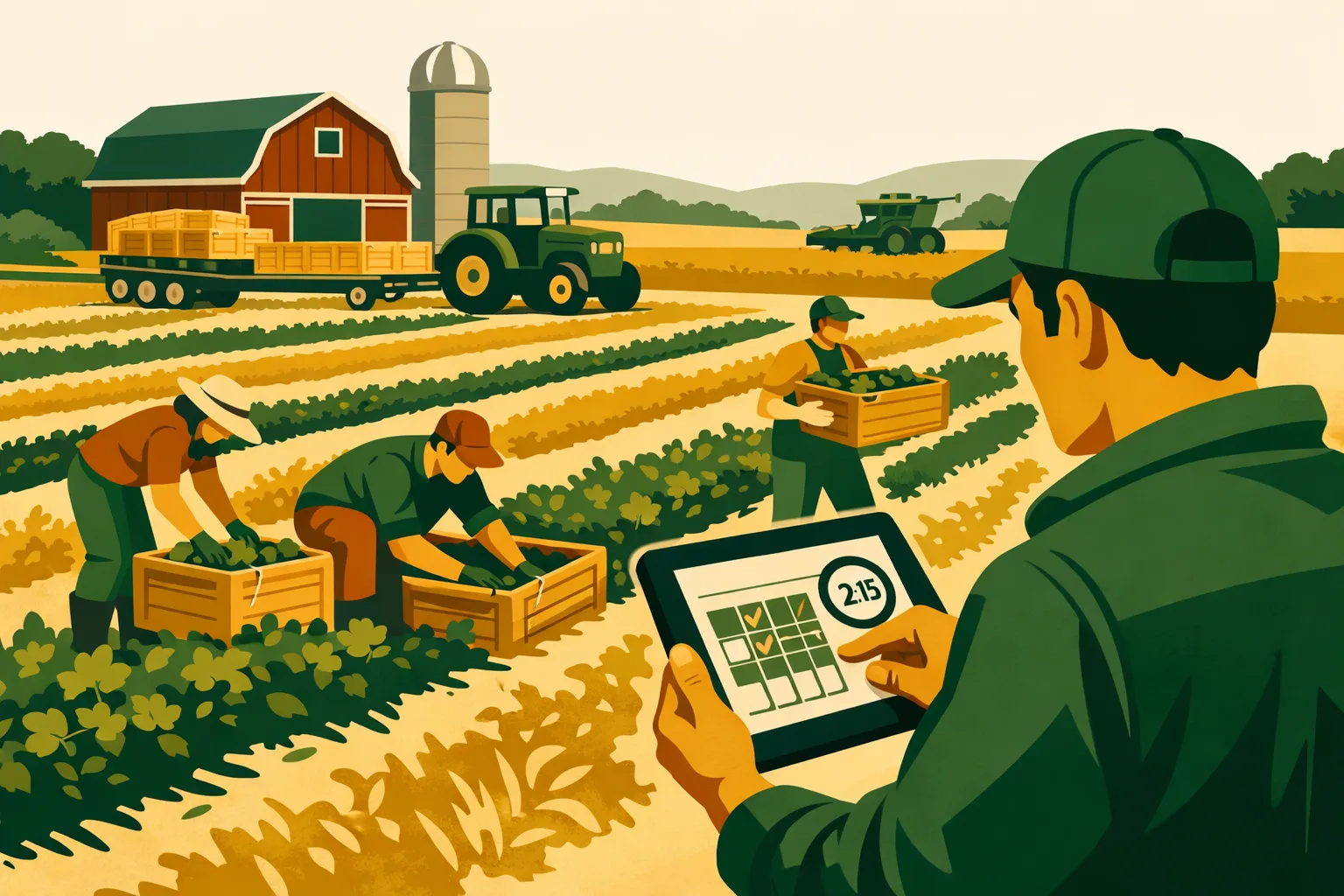
Managing labor hours efficiently is a crucial aspect of running a successful commercial farm. With operations sprawling across hundreds or thousands of acres, inaccurate or inefficient tracking can lead to significant financial losses. This article explores four different methods of farm employee time tracking, tested over a full season, to determine their effectiveness. From traditional paper logs to advanced farm-specific software, we evaluate each method’s strengths and limitations.
Understanding the Need for Efficient Time Tracking
In large-scale farming, labor is one of the most significant operational costs. Accurate tracking of farm labor hours ensures fair compensation, regulatory compliance, and insights into labor efficiency. As farms grow, keeping track of employee hours manually becomes increasingly complex and prone to errors. Let’s dive into the four tracking methods we tested.
1. Paper Logs: The Traditional Approach
Pros and Cons of Paper Logs
Pros:
- Simplicity: Paper logs require no technical skills or electronic devices.
- No Upfront Costs: No need for software purchases or subscriptions.
Cons:
- Prone to Errors: Handwritten entries can be illegible or inaccurate.
- Time-Consuming: Consolidating data from paper logs is labor-intensive.
- Lack of Real-Time Data: Delays in data entry can result in outdated information.
Practical Use Case
During our season-long test, paper logs were used on a 500-acre corn and soybean farm. While workers found the system easy to use, farm managers reported frequent discrepancies requiring additional verification efforts.
2. Punch Clocks: An Upgrade in Simplicity
Pros and Cons of Punch Clocks
Pros:
- Easy to Use: Familiar to many workers, reducing the learning curve.
- Increased Accuracy: Minimizes the risk of manual entry errors.
Cons:
- Limited Flexibility: Fixed location can be inconvenient for field workers.
- Maintenance Required: Physical devices require upkeep and calibration.
Practical Use Case
A 1,000-acre dairy farm implemented punch clocks across multiple facilities. While accuracy improved over paper logs, the need for workers to return to a central location to clock in and out was inefficient.
3. Generic Time-Tracking Apps: The Digital Leap
Pros and Cons of Generic Apps
Pros:
- Accessibility: Available on smartphones, increasing ease of access.
- Automated Calculations: Reduces the risk of calculation errors.
Cons:
- Lack of Farm-Specific Features: Not tailored to agriculture-specific needs.
- Connectivity Issues: Dependence on internet access can be a limitation in rural areas.
Practical Use Case
On a 2,000-acre mixed-crop farm, a generic time-tracking app was deployed. While it provided automation benefits, farmers noted its lack of features for tracking field-specific tasks and conditions.
4. Farm-Specific Software: A Tailored Solution
Pros and Cons of Farm Software
Pros:
- Designed for Farming: Includes agricultural-specific features like field task tracking.
- Real-Time Data: Access to live updates improves decision-making.
Cons:
- Initial Setup Costs: Higher upfront investment for software and training.
- Learning Curve: Requires employee training to maximize benefits.
Practical Use Case
A 4,500-acre grain farm utilized a farm-specific software solution. Despite initial setup challenges, the ability to track labor in conjunction with field operations provided valuable insights into labor distribution and productivity.
Comparison Table: Methods at a Glance
| Method | Ease of Use | Accuracy | Flexibility | Cost | Farm-Specific Features |
|---|---|---|---|---|---|
| Paper Logs | High | Low | Low | Low | No |
| Punch Clocks | Medium | Medium | Low | Medium | No |
| Generic Apps | High | Medium | High | Low | Limited |
| Farm Software | Medium | High | High | High | Yes |
Actionable Checklist for Choosing the Right Method
- Assess Farm Size and Complexity: Larger operations may benefit more from specialized software.
- Evaluate Budget Constraints: Consider both upfront and ongoing costs.
- Determine Connectivity Needs: Ensure chosen methods align with available infrastructure.
- Consider Employee Tech Savviness: Choose a system that matches your workforce’s comfort with technology.
- Pilot Test a Solution: Implement a trial run to gauge effectiveness before full deployment.
How FarmsFlo Helps
FarmsFlo specializes in providing farm-specific time-tracking solutions designed to meet the unique demands of agriculture operations. Our software integrates seamlessly with your existing systems to provide real-time data, improve accuracy, and optimize labor efficiency. By choosing FarmsFlo, you can reduce errors, streamline payroll processes, and gain valuable insights into labor distribution and productivity.
Labor hours are only half the log. Keep machine hours next to them. → See also: free equipment maintenance log so machine hours sit next to labor hours.
Use equipment maintenance tracking software when labor hours and machine hours both matter when the same weekly review needs labor costs and service intervals in one place.
Explore how FarmsFlo can transform your farm operations. Start your free trial today.
By testing these methods across a full season, we have highlighted the strengths and weaknesses of each approach to farm employee time tracking. For farms looking to optimize their operations, the tailored solutions offered by farm-specific software, like FarmsFlo, provide the most comprehensive benefits, making them a worthwhile investment for the future.