5 Reasons Herd Management Software Will Actually Transform Your Farm Operations by 2026
Five reasons herd-management software pays in 2026: one animal ID, faster vet lists, cleaner breeding notes, and less time rebuilding the same whiteboard.
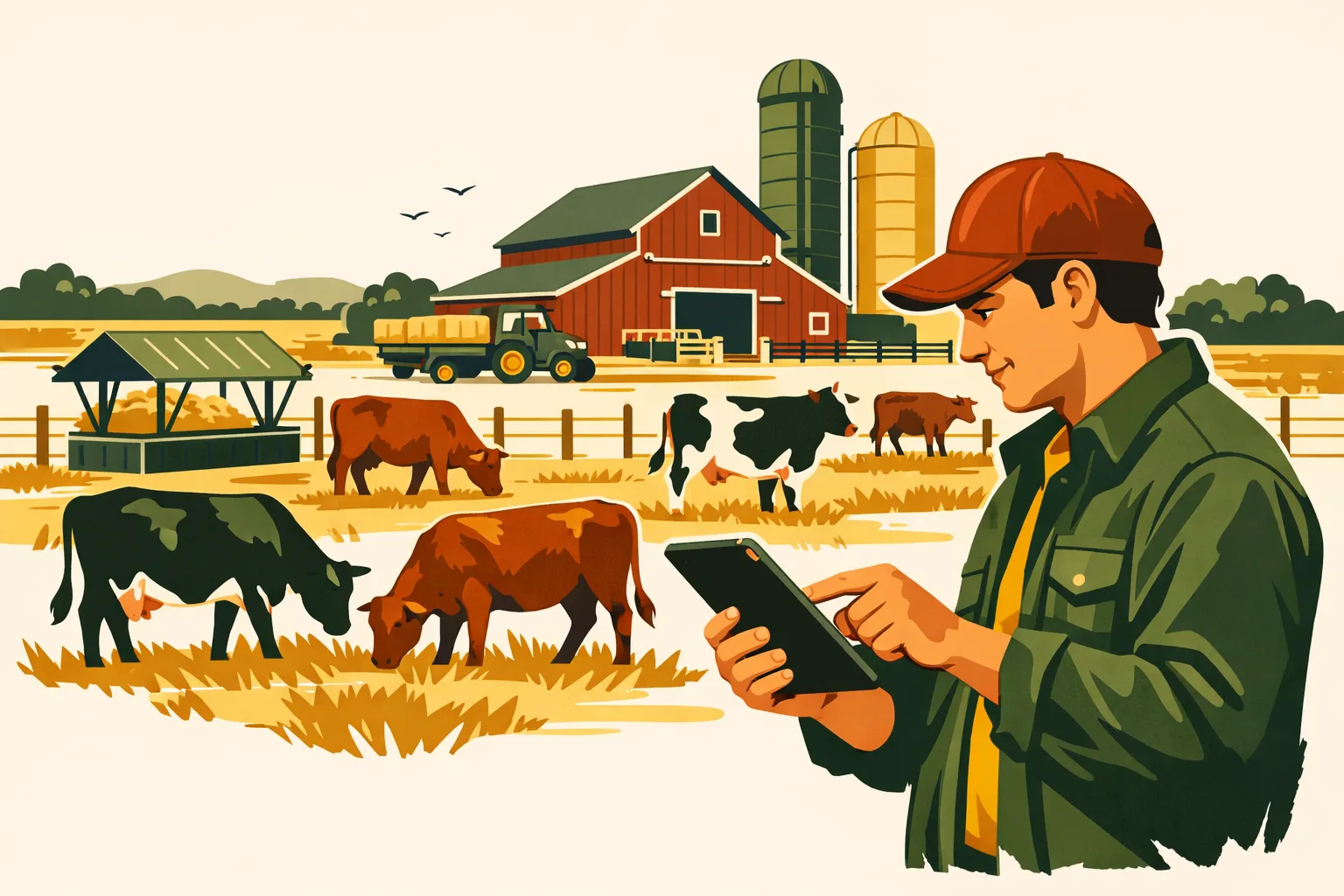
A missed heat, an unrecorded treatment, or a misplaced calf record rarely looks expensive in the moment. But across a commercial herd, those small gaps compound into delayed breeding, avoidable vet calls, poor culling decisions, compliance risk, and hours of office work that should have been handled in the field. The farms that get ahead by 2026 will not be the ones with the most data — they will be the ones using herd data fast enough to make better decisions while the work is still happening.
Herd management software gives livestock operations a central operating system for animal records, breeding, health, inventory, tasks, reporting, and financial decisions. For farm managers running 50 to 5,000+ acres, the value is not “going digital” for its own sake. The value is tighter execution: fewer missed jobs, cleaner records, faster decisions, and better accountability across the crew.
This guide breaks down where herd management software creates real operational gains, what it costs to implement, how to choose the right platform, and how to roll it out without disrupting the farm.
For more farm technology guidance, see FarmsFlo’s software resources and farm operations guides.
What Herd Management Software Does on a Commercial Farm
Herd management software is a digital system used to record, manage, and analyze animal-level and herd-level information. Depending on the operation, it may cover:
- Animal identification and lifetime records
- Breeding and reproductive status
- Calving, lambing, kidding, or farrowing records
- Health treatments, vaccinations, withdrawals, and vet notes
- Weaning, weights, performance, and gains
- Feed groups and inventory links
- Pasture or pen movements
- Cull lists and replacement decisions
- Compliance and audit documentation
- Task assignments for employees
- Reports for lenders, veterinarians, processors, certifiers, or management
For dairy farms, herd management software often connects with parlor systems, milk meters, activity monitors, and reproductive tools. For beef, sheep, goat, or mixed livestock operations, it may focus more on breeding records, grazing groups, animal health, inventory, and performance tracking.
The core purpose is the same: replace scattered notebooks, memory-based management, and disconnected spreadsheets with a reliable system that supports daily decisions.
Reason 1: Better Decisions From Clean, Centralized Herd Records
Most commercial livestock operations already collect valuable information. The problem is that the information is often spread across clipboards, whiteboards, text messages, vet invoices, spreadsheets, notebooks, and employee memory.
That creates a management bottleneck. If a farm manager has to search three places to answer a basic question, the data is not operational yet.
Herd management software centralizes records so the farm can make decisions from one source of truth.
Records That Should Be Centralized
At minimum, a commercial herd system should store:
- Animal ID, tag number, EID/RFID, and group
- Breed, sex, birth date, dam, sire, and source
- Current location, pasture, pen, barn, or grazing group
- Breeding dates, pregnancy checks, and expected calving dates
- Calving history and offspring records
- Treatments, vaccinations, and withdrawal periods
- Weights, body condition scores, gains, and performance notes
- Feed or ration group where relevant
- Sales, transfers, mortality, and culling reason
- Ownership, lease, or custom-grazing status if applicable
When these records are searchable, sortable, and available from a phone or tablet, they become useful during real farm work.
Practical Example: Culling Decisions
Without reliable records, culling decisions can become reactive. The animal that looks poor today may not be the biggest economic drag. The real problem may be the cow that bred late three years in a row, needed repeated treatments, weaned below-average calves, and still looks acceptable at a glance.
With herd management software, you can filter for:
- Open females after preg-check
- Late calvers
- Repeated treatment history
- Low weaning weight performance
- Poor disposition notes
- Structural or udder problems
- Age and production trends
That turns culling from a memory-based discussion into a structured management process.
Practical Example: Replacement Selection
Replacement heifers or breeding females should not be selected only on appearance. A digital herd record helps compare:
- Dam productivity
- Calving interval
- Birth and weaning weights
- Treatment history
- Breeding date
- Sire line
- Temperament
- Growth performance
This improves consistency across years, especially when multiple family members, managers, or employees are involved in selection.
Time and Cost Estimate
For a commercial operation moving from paper or spreadsheets to herd management software, expect:
- Initial data cleanup: 4–20 hours for smaller herds; 20–80+ hours for large or multi-site herds
- Animal record import: 1–5 days depending on data quality
- Staff onboarding: 2–6 short training sessions
- Ongoing daily use: 5–20 minutes per user per day, depending on complexity
- Software cost: often priced per head, per user, per module, or monthly subscription
The biggest upfront cost is usually not the software. It is the time required to clean old records and build a consistent process.
Reason 2: Reproduction Management Gets More Timely and Less Dependent on Memory
Reproductive performance drives cash flow in livestock operations. Missed heats, late pregnancy checks, unclear breeding dates, and poor follow-up can quietly reduce revenue and increase feed costs.
Herd management software helps managers stay ahead of the reproductive calendar.
Where Digital Reproduction Tools Help
A good system should allow the farm to track:
- Heat observations
- AI dates
- Natural service exposure dates
- Pregnancy check results
- Expected calving, lambing, kidding, or farrowing dates
- Open animals
- Recheck lists
- Dry-off dates for dairy herds
- Sync protocol tasks
- Postpartum or rebreeding intervals
- Sire assignments and breeding groups
The practical advantage is not just recordkeeping. It is task timing.
Instead of relying on someone to remember that a group needs checked next week, herd management software can generate a worklist.
Reproduction Worklists That Matter
Commercial operations should use software-generated lists for:
- Animals due for heat check
- Animals due for synchronization injections
- Animals ready for AI
- Females needing preg-check
- Open females needing a decision
- Animals close to calving
- Post-calving health checks
- Breeding groups needing bull rotation
- Bulls needing breeding soundness exams
These lists reduce the chance that reproductive management depends on one person’s memory.
Dairy, Beef, and Small Ruminant Applications
For dairy operations, herd management software may integrate with activity monitors and milk data, helping identify cows needing attention. For beef operations, the software is often most valuable for breeding group management, preg-check lists, calving windows, and replacement decisions. For sheep and goat operations, the value often comes from managing groups, lambing/kidding records, treatment histories, and cull decisions by ewe or doe line.
The best system depends on how your operation works. A pasture-based cow-calf ranch does not need the same setup as a freestall dairy, and a seedstock operation needs more detailed pedigree and performance tools than a commercial feeder.
Management Outcome
By 2026, reproductive management will continue shifting from “check the notebook” to “work the list.” That is the real change.
The manager’s job becomes:
- Set the protocol.
- Make sure every animal is in the right status.
- Assign the work.
- Review exceptions.
- Act quickly on animals that fall outside the plan.
That is a higher level of control than handwritten breeding books can deliver at scale.
For related operational planning, see FarmsFlo’s livestock management resources and farm operations category.
Reason 3: Health Records, Treatments, and Compliance Become Defensible
Animal health records are not just internal notes. They affect food safety, audit readiness, residue prevention, animal welfare verification, and customer confidence.
Herd management software helps commercial farms maintain accurate health records that can be used during inspections, audits, vet reviews, and buyer conversations.
What a Strong Health Record Should Include
Every treatment record should capture:
- Animal ID or group ID
- Date and time of treatment
- Product used
- Dosage
- Route of administration
- Reason for treatment
- Person who administered it
- Lot number when required or useful
- Withdrawal period
- Clearance date
- Vet instructions or protocol reference
- Follow-up task
For farm-scale operations, the key is making this easy enough that employees actually enter the information.
If a system is too slow in the chute, barn, or pasture, the crew will go back to paper. The best herd management software supports quick entry from mobile devices, bulk treatment entry, protocol templates, barcode or RFID use, and offline access where connectivity is weak.
Withdrawal Management
Residue risk is one of the strongest reasons to digitize treatment records. A handwritten note on a barn clipboard is easy to miss when animals move between groups or when several employees are involved.
Herd management software can flag:
- Animals currently under withdrawal
- Animals clear for sale or processing
- Milk withhold periods in dairy systems
- Group treatments requiring follow-up
- Animals that should not be shipped
This matters for any operation selling into commercial channels.
Working With Veterinarians
Digital records also improve vet relationships. Instead of calling the veterinarian with rough estimates, the farm can provide:
- Treatment frequency by disease category
- Repeat treatment cases
- Mortality notes
- Vaccination history
- Calving difficulty patterns
- Lameness or respiratory trends
- Protocol compliance
That allows the vet to help improve protocols rather than simply respond to emergencies.
Compliance and Audit Readiness
Different operations face different documentation requirements depending on species, market, certifications, state rules, processor standards, and customer expectations. Herd management software can help prepare for:
- Animal health audits
- Quality assurance programs
- Organic or specialty market documentation
- Source and age verification
- Movement records
- Medication inventory records
- Employee treatment accountability
- Processor or buyer record requests
No software replaces management discipline. But it does make records easier to retrieve and harder to lose.
For more on documentation and operational controls, visit FarmsFlo’s compliance resources and farm business management guides.
Reason 4: Labor Efficiency Improves Because Work Becomes Visible
Labor is one of the biggest constraints on commercial farms. Even well-run operations lose time when tasks are unclear, duplicated, forgotten, or communicated only verbally.
Herd management software can improve labor efficiency by turning herd events into actionable work.
Where Time Gets Lost Without Software
Common time leaks include:
- Employees checking the same animals twice
- Missed follow-up treatments
- Confusion over which group moved where
- Searching for records before shipping
- Rebuilding reports manually
- Calling multiple people to confirm breeding status
- Re-entering data from paper into spreadsheets
- Losing notes from the chute, parlor, or pasture
- Delayed decisions because the manager lacks current information
None of these may seem major alone. Across a season, they add up.
Task Management for Livestock Teams
Some herd management platforms include built-in task tools. Others integrate with farm task software or require a separate process. Either way, livestock teams should be able to assign and track:
- Preg-check lists
- Vaccination days
- Treatment follow-ups
- Calving checks
- Sorting and shipping work
- Weighing events
- Pasture moves
- Pen cleaning or bedding tasks
- Feed group changes
- Bull turnout and removal dates
- Vet visits
- Equipment setup for processing days
When tasks are tied to animal records, managers can verify what was done and what still needs attention.
Mobile Use Matters
For commercial operations, desktop-only herd software is a problem. The work happens in barns, lots, pastures, working facilities, parlors, and trucks.
Look for mobile features such as:
- Offline data entry
- Fast search by tag or EID
- Bulk entry for group events
- Voice notes or quick comments
- Photo attachments
- Treatment templates
- Real-time syncing when connected
- Role-based employee access
- Simple worklists for field staff
A good mobile setup reduces double entry. The person doing the work records it once, at the point of work.
Labor Planning Benefit
Better records also help managers plan labor. If the software shows a heavy calving window, upcoming vaccination day, scheduled preg-check, and several pasture moves, the manager can staff accordingly.
That is especially valuable for farms using seasonal employees, part-time help, custom crews, or family labor spread across multiple enterprises.
Time Estimate: Paper vs. Digital Workflows
The labor savings depend on herd size, reporting burden, and current record quality. A realistic expectation is that digital systems reduce time spent searching, rewriting, and reconciling records once the team is trained.
The farm may not “save time” in the first few weeks. Early adoption can feel slower because employees are learning new steps. After the process is established, the major gain is fewer record gaps, less rework, and faster management review.
Comparison: Paper, Spreadsheets, and Herd Management Software
| Management Area | Paper Records | Spreadsheets | Herd Management Software |
|---|---|---|---|
| Field data entry | Fast but easy to lose or misread | Difficult on phones; often delayed | Designed for mobile or chute-side use |
| Animal history | Hard to search across years | Searchable if well maintained | Searchable by animal, group, event, or date |
| Reproduction tracking | Depends on manual calendars | Better, but formulas can break | Worklists, alerts, status tracking |
| Health treatments | Risk of missing withdrawal details | Better structure, still manual | Treatment templates, withdrawal flags, audit reports |
| Employee accountability | Limited | Limited unless tightly controlled | User-based records and assigned tasks |
| Reporting | Slow manual summaries | Flexible but time-consuming | Built-in reports and exports |
| Multi-site operations | Difficult | Possible but version control issues | Centralized access across locations |
| Data quality | Varies by handwriting and discipline | Varies by spreadsheet design | Stronger if required fields and templates are used |
| Best fit | Very small or simple herds | Transitional systems | Commercial operations needing repeatable control |
Spreadsheets can work for a period, especially on smaller operations with one decision-maker. But as herd size, labor complexity, compliance needs, or enterprise diversity increase, spreadsheets become fragile. Herd management software provides structure that is hard to maintain manually.
Reason 5: Financial and Performance Decisions Get Tied to the Animals Driving Them
Farm profitability is not just about total revenue and total expense. Livestock managers need to know which animals, groups, sires, age classes, pastures, or systems are producing results.
Herd management software helps connect production events with financial decisions.
Performance Metrics Worth Tracking
Commercial operations should consider tracking:
- Birth weights where relevant
- Weaning weights
- Average daily gain
- Pregnancy rate by group
- Calving distribution
- Treatment cost by animal or group
- Death loss records
- Cull reasons
- Feed group performance
- Pasture performance by grazing group
- Sale weights and sale dates
- Replacement development outcomes
- Milk production and components for dairy
- Somatic cell count and health events for dairy
- Lambing or kidding percentage where relevant
The right metrics depend on the enterprise. Do not track everything simply because software allows it. Track the data that changes decisions.
Turning Data Into Decisions
Useful decisions include:
- Which females to cull
- Which heifers to retain
- Which bulls or sires to use again
- Which breeding groups need different management
- Which health protocols are not working
- Whether replacements are paying their way
- Which pasture groups performed better
- Whether late-born animals should be sold differently
- Whether a feed change improved performance
- Whether a buyer, processor, or market channel produced better net returns
The goal is not pretty reports. The goal is management action.
Linking Herd Software With Financial Management
Some herd management software includes cost tracking. Others integrate with accounting or farm management platforms. At minimum, managers should be able to export useful data for financial analysis.
For example:
- Treatment costs by disease category
- Cull revenue by reason
- Sale weights by group
- Replacement development cost per head
- Calf crop records by cow age
- Mortality by period
- Feed-related performance data
This supports better budgeting and capital planning.
For broader planning, see FarmsFlo’s farm finance resources and software category.
What Herd Management Software Costs
Pricing varies widely by species, herd size, features, integrations, and support level. Before choosing a platform, estimate total cost of ownership, not just subscription price.
Common Cost Categories
Expect some combination of:
- Monthly or annual software subscription
- Per-head fees
- Per-user fees
- Setup or onboarding fees
- Data import fees
- Mobile devices or rugged tablets
- EID/RFID tags
- Handheld or panel readers
- Scale head integration
- Chute-side hardware
- Internet or connectivity upgrades
- Staff training time
- Ongoing support or consulting
Typical Budget Ranges
Actual prices vary by vendor and region, but commercial farms often plan around these general categories:
- Basic software subscription: lower monthly cost for records and simple reporting
- Advanced herd platform: higher monthly or annual cost for integrations, analytics, and multi-user access
- EID/RFID tags: usually a per-head cost
- Handheld RFID reader: commonly a mid-range equipment purchase
- Fixed readers, scale integration, or chute systems: larger capital expense
- Training and setup: internal labor plus any vendor onboarding fee
A smaller commercial herd may start with software and manual tag entry. A larger operation may justify EID integration, scales, and multiple mobile users from the beginning.
Cost Control Tip
Do not buy every module on day one. Start with the workflows that will produce the fastest operational return:
- Animal inventory
- Reproduction status
- Health treatments and withdrawals
- Worklists
- Sale/cull decisions
- Performance reporting
Once the crew is using the system reliably, add integrations and deeper analytics.
How to Choose the Right Herd Management Software
Choosing herd management software is an operations decision, not just a technology purchase. The right platform must fit your herd, labor structure, facilities, and management goals.
Key Selection Criteria
Use these criteria when comparing options:
- Species and enterprise fit
- Ease of use in the field
- Offline capability
- Mobile app quality
- Bulk entry tools
- EID/RFID compatibility
- Scale and chute integration
- Reproduction management features
- Treatment and withdrawal tracking
- Reporting flexibility
- Multi-user permissions
- Data export options
- Customer support quality
- Training resources
- Integration with accounting or farm management systems
- Long-term data ownership and portability
Questions to Ask Vendors
Before signing a contract, ask:
- Can we import existing animal records?
- What format does the import require?
- Can the system work without cell service?
- How does it handle group treatments?
- Can employees have limited permissions?
- Can we export all data if we leave?
- Does it support our EID reader and scale head?
- How are withdrawal periods tracked?
- Can we create custom fields?
- What reports are built in?
- What support is included?
- How long does onboarding usually take?
- Are training sessions recorded?
- How often is the software updated?
- Does pricing change as the herd grows?
If the vendor cannot explain how the software works during a real processing day, keep looking.
90-Day Implementation Checklist for Commercial Farms
Rolling out herd management software should be treated like an operational project. The goal is not to “install an app.” The goal is to change how records and tasks flow through the farm.
Days 1–15: Prepare the Foundation
- Choose one project lead responsible for rollout
- Define which herd records must be accurate from day one
- Gather current spreadsheets, notebooks, tag lists, vet records, and sale records
- Clean duplicate animal IDs
- Decide naming and tag conventions
- Identify active, sold, culled, dead, and transferred animals
- Review hardware needs: phones, tablets, readers, scales, printers
- Confirm internet or offline requirements at working facilities
- Set user roles for owners, managers, employees, vets, or consultants
- Build a short list of must-have reports
Days 16–30: Configure the System
- Import animal inventory
- Set up groups, locations, pastures, pens, or barns
- Add breeding seasons or production cycles
- Build treatment templates
- Add withdrawal rules where applicable
- Configure reproduction statuses
- Create standard cull reasons
- Create task categories
- Test mobile access in real working locations
- Connect EID readers or scales if used
- Run a small test with 10–25 animals before full deployment
Days 31–60: Train and Use on Real Work
- Train managers first, then field employees
- Record one real processing event in the system
- Assign tasks through the software
- Enter treatments at the point of work
- Track breeding or preg-check updates
- Review data accuracy after each major event
- Fix workflow problems quickly
- Remove duplicate paper steps where safe
- Build weekly review habits
- Document standard operating procedures
Days 61–90: Review and Improve
- Compare software inventory to physical herd inventory
- Review open tasks and overdue items
- Check health records for missing fields
- Review breeding and pregnancy status reports
- Generate cull or sale candidate lists
- Review staff adoption and training gaps
- Decide which paper records can be retired
- Add advanced reports only after core use is stable
- Schedule quarterly data cleanup
- Set goals for the next production cycle
A disciplined 90-day rollout is better than a rushed launch that leaves employees frustrated and records half-complete.
Common Mistakes That Undercut Results
Herd management software works only when the farm changes the process around it. Avoid these mistakes.
Mistake 1: Starting With Dirty Data
If animal IDs are duplicated, inactive animals are still listed as active, and breeding records are unclear, the software will not fix the problem automatically. Clean the core inventory before launch.
Mistake 2: Overcomplicating Day One
Do not require employees to enter 20 fields for every event at the start. Begin with essential records, then add detail once adoption is solid.
Mistake 3: Keeping Parallel Systems Too Long
Some overlap with paper is normal during transition. But if employees must enter everything on paper and then again in software, adoption will stall. Remove duplicate steps as soon as the digital process is reliable.
Mistake 4: Choosing Software Without Field Testing
A platform that looks good in an office demo may fail at the chute or in a low-signal pasture. Test the mobile workflow before committing.
Mistake 5: Failing to Assign Ownership
Someone must be responsible for data quality, user training, report review, and workflow updates. Without ownership, the system becomes another neglected tool.
Where Herd Management Software Creates the Fastest Payback
Not every farm gets value in the same place. The fastest return depends on your current bottleneck.
If Your Bottleneck Is Reproduction
Prioritize:
- Breeding status
- Heat detection records
- Preg-check worklists
- Expected calving dates
- Open animal reports
- Calving distribution reports
If Your Bottleneck Is Health
Prioritize:
- Treatment templates
- Withdrawal tracking
- Vet protocol records
- Follow-up tasks
- Repeat treatment reports
- Mortality and morbidity summaries
If Your Bottleneck Is Labor
Prioritize:
- Mobile worklists
- Employee task assignments
- Bulk event entry
- Offline use
- Multi-user permissions
- Simple daily dashboards
If Your Bottleneck Is Profitability Analysis
Prioritize:
- Weights and performance records
- Sale groups
- Cull reasons
- Replacement tracking
- Treatment cost categories
- Exportable reports for financial review
The best implementation starts with the farm’s biggest operational pain, not the software’s longest feature list.
What to Expect by 2026
By 2026, herd management software will be less of a “nice to have” and more of a standard operating tool for commercial livestock farms that need reliable records, employee coordination, and faster decisions.
Several trends are pushing in that direction:
- More use of EID/RFID across livestock sectors
- Greater buyer interest in traceability and documentation
- Continued pressure on labor efficiency
- More integrations between scales, readers, sensors, accounting systems, and farm management platforms
- Increasing need to prove treatment, welfare, and production practices
- More data-driven replacement, culling, and breeding decisions
The farms that benefit most will be the ones that build clean workflows now. Technology alone will not transform operations. Better systems, better habits, and better decision timing will.
How FarmsFlo Helps
FarmsFlo helps commercial farm teams bring daily operations, records, tasks, and management visibility into one practical workflow. If your livestock operation is ready to move beyond scattered spreadsheets, notebooks, and verbal follow-up, FarmsFlo gives managers a clearer way to organize work and keep the team aligned.
With FarmsFlo, you can support better execution across:
- Daily and seasonal farm tasks
- Team communication
- Operational checklists
- Record organization
- Work planning
- Farm management visibility
- Multi-enterprise coordination
Herd management software is most powerful when it fits into the broader operating rhythm of the farm. FarmsFlo helps connect the people, tasks, and processes around those records so decisions turn into completed work.
Start by reviewing your current herd record gaps, choose the workflows that need the most control, and build a rollout plan your crew can actually follow.
Ready to tighten up your farm operations? Try FarmsFlo with a trial at farmsflo.com.